

Az Eötvös Loránd Tudományegyetem
Társadalomtudományi Kar
AI Persuasion, Society and Trust 2027
International Interdisciplinary Conference on Generative AI, Credibility, Markets and Public Reasoning
When Artificial Intelligence Persuades: The Future of Credibility - Persuasion, Society and Public Trust in the Age of Generative AI
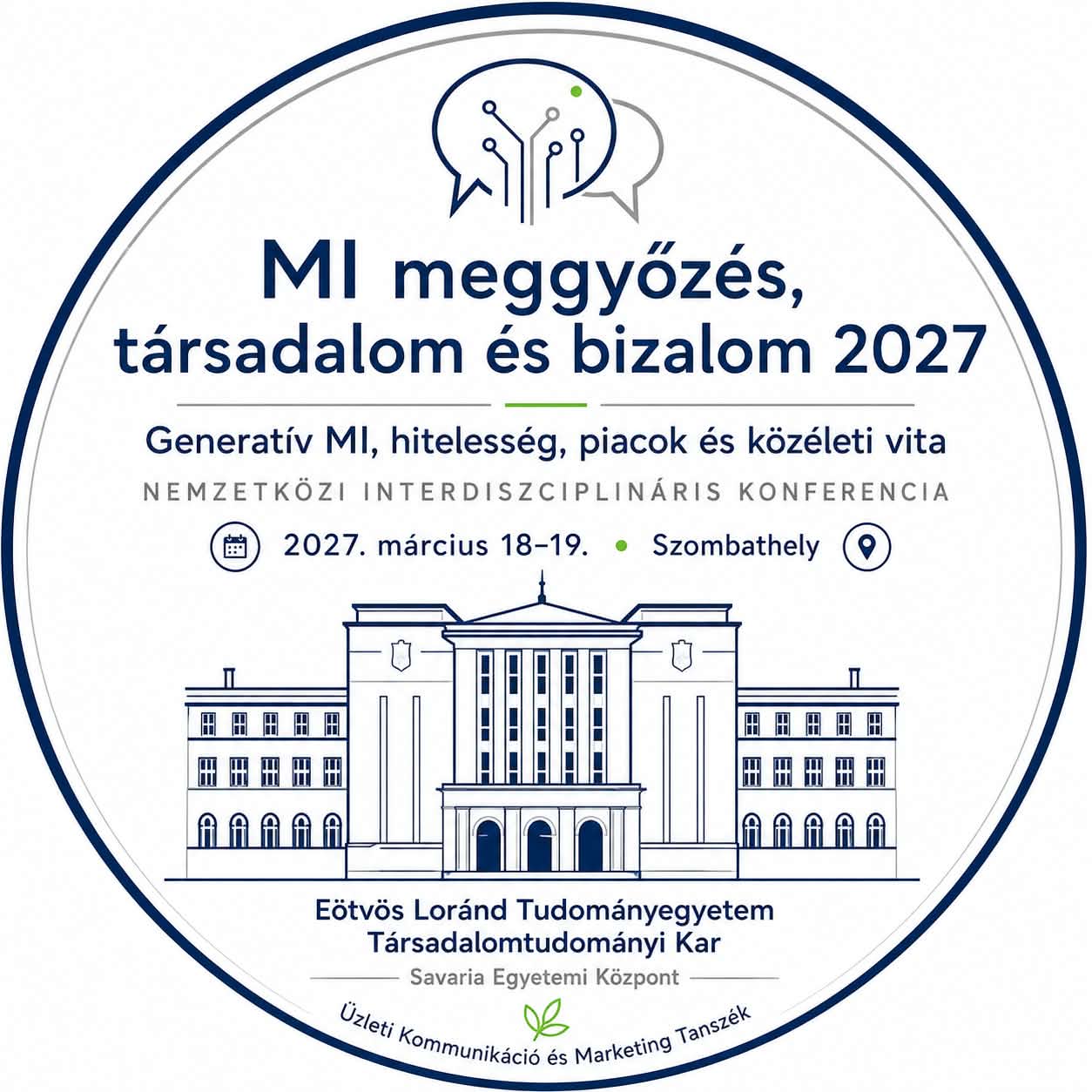
| Date: | 18-19 March 2027 |
| Venue | Eötvös Loránd Tudományegyetem Társadalomtudományi Kar Közgazdaságtudományi Intézet 9700 Szombathely, Károlyi Gáspár tér 4. |
For a long time, artificial intelligence was understood as a technology that computes, makes predictions, and optimises processes. This picture has become inadequate. Today's generative systems no longer merely process information: they argue, recommend, build narratives, negotiate, advertise, and persuade. They write corporate sustainability reports and expose greenwashing in them, they personalise political messages and consumer offers, they simulate actors, produce evidence, and increasingly shape what the public believes and where markets move.
This marks a shift in what AI is for. As artificial intelligence becomes a persuasive and strategic actor, the decisive question is no longer just what AI can do, but whether we can trust what it says - and what becomes of credibility, sustainability, and public reasoning when persuasion itself can be produced in arbitrary quantities, instantly, and at near-zero cost.
The conference's central question is: when does AI-driven persuasion strengthen trust, sustainable decisions, and transparent markets - and when does it turn into manipulation, greenwashing, or industrial-scale strategic distortion?
The stakes are sharpest precisely where these questions are least examined together. Economics analyses strategic communication as "signalling" and "cheap talk" - supposedly morally neutral. Ethics sees the same behaviour as "manipulation" - supposedly morally loaded. Marketing and communication research study persuasion as a craft, argumentation theory views it as the act of giving reasons, sustainability research experiences it as the gap between green claims and green action. Generative AI adds a reflexive twist that exists nowhere else: the same model can produce a persuasive sustainability claim and expose it. No single discipline owns this problem. AI Persuasion, Society and Trust 2027 aims to bring these conversations into one room - organised around a single tension, not parallel tracks.
We welcome contributions from economics, game theory, argumentation theory, philosophy, marketing and PR, communication studies, environmental and sustainability research, law and governance, computer science, media studies, sociology, political science, management studies, science and technology studies, and related fields, as well as practitioners working on AI, trust, sustainability communication, responsible innovation, public policy, or institutional accountability.
Thematic Axes
1. AI as Persuader
Large language models and the new science of machine persuasion: personalised and mass influence, the persuasion-accuracy trade-off, the boundary between rational persuasion and manipulation, and the fate of epistemic autonomy.
2. AI, Green Claims, and Sustainability
Greenwashing and ESG communication in the generative age - where the same system can both produce and detect environmental claims. Green marketing, consumer trust, and the credibility of sustainability signals.
3. AI, Markets, and Strategic Interaction
Game-theoretic and economic perspectives: signalling theory and cheap talk, AI agents in markets and on platforms, incentives, competition, strategic communication, and the risk of algorithmic collusion.
4. AI, Argumentation, and Public Reasoning
Computational argumentation and argument mining, AI as a reason-giver and reason-evaluator, the tension between probative force and rhetorical style, what machine reasoning does to public discourse.
5. AI Governance, PR, and Accountability
The EU AI Act and beyond, corporate communication, reputation, and accountability, transparency, provenance, and the institutional design of trustworthy AI communication.
6. The Environmental Cost of AI
Green AI and the resource footprint of computation - energy, water, and carbon, Jevons paradox and rebound effects, whether efficiency can ever truly make AI sustainable.
7. Open Interdisciplinary Forum
We also welcome presentations that approach AI persuasion, credibility, sustainability, trust, or public reasoning from other disciplinary, methodological, or practical perspectives. Contributions are not limited to the thematic axes above. The conference is designed as an open interdisciplinary forum for researchers and practitioners who can illuminate how generative AI reshapes persuasion, judgement, institutional credibility, markets, democratic communication, or sustainable action.
Invited Speakers
Plenary speakers will be announced on the conference website. The programme is built around four invited perspectives:
- AI ethics and responsible AI
- AI and the sustainability transition
- persuasion, communication, and marketing
- a practitioner roundtable on AI, trust, and sustainability communication
Languages
The working languages of the conference are English and Hungarian. A parallel Hungarian-language track will also run. Abstracts may be submitted in English or Hungarian.
Application
Applications can be submitted via the link below: application
Submission
Please submit an anonymised abstract of 400-600 words, indicating the relevant thematic axis or the Open Interdisciplinary Forum. All abstracts will undergo review by the international programme committee. Submissions should be prepared for anonymous review and should not include author names or institutional identifiers in the abstract document.
Important Dates
| Event | Date |
|---|---|
| Abstract submission deadline | 10 January 2027 |
| Notification of acceptance | 1 February 2027 |
| Presenter confirmation and registration | 15 February 2027 |
| Preliminary programme | 22 February 2027 |
| Final programme | 5 March 2027 |
| Conference | 18-19 March 2027. |
| Full paper submission for the conference volume | 31 May 2027 |
Publication
Conference Volume
Upon the author's request, every accepted paper may appear in the conference volume published by Savaria University Press, with ISBN/DOI.
Journal Route
Authors who wish to develop their work for an academic journal may opt for non-archived presentation. A selected set of papers will be invited to submit extended versions to Polanyiana, an open-access academic journal included in the relevant MTA journal lists and publishing peer-reviewed research articles.
The planned journal route is especially suitable for papers addressing the epistemic, ethical, social, communicative, philosophical, or institutional dimensions of AI persuasion, credibility, trust, sustainability, and public reasoning.
Submission to the journal route does not imply acceptance. Conference acceptance and journal review are entirely separate processes, and all journal submissions will be evaluated in accordance with the journal's independent review standards.
Organiser
Eötvös Loránd University (ELTE), Faculty of Social Sciences - Department of Business Communication and Marketing – Dr. Zsolt Ziegler - ziegler.zsolt@sek.elte.hu
| Dr. Zsolt Ziegler | Chair of the Conference Organizing Committee |
| Prof. Dr. László Kovács | Co-organizer of the Conference |